How to Ask for a Blowout Taper: The Exact Words to Use
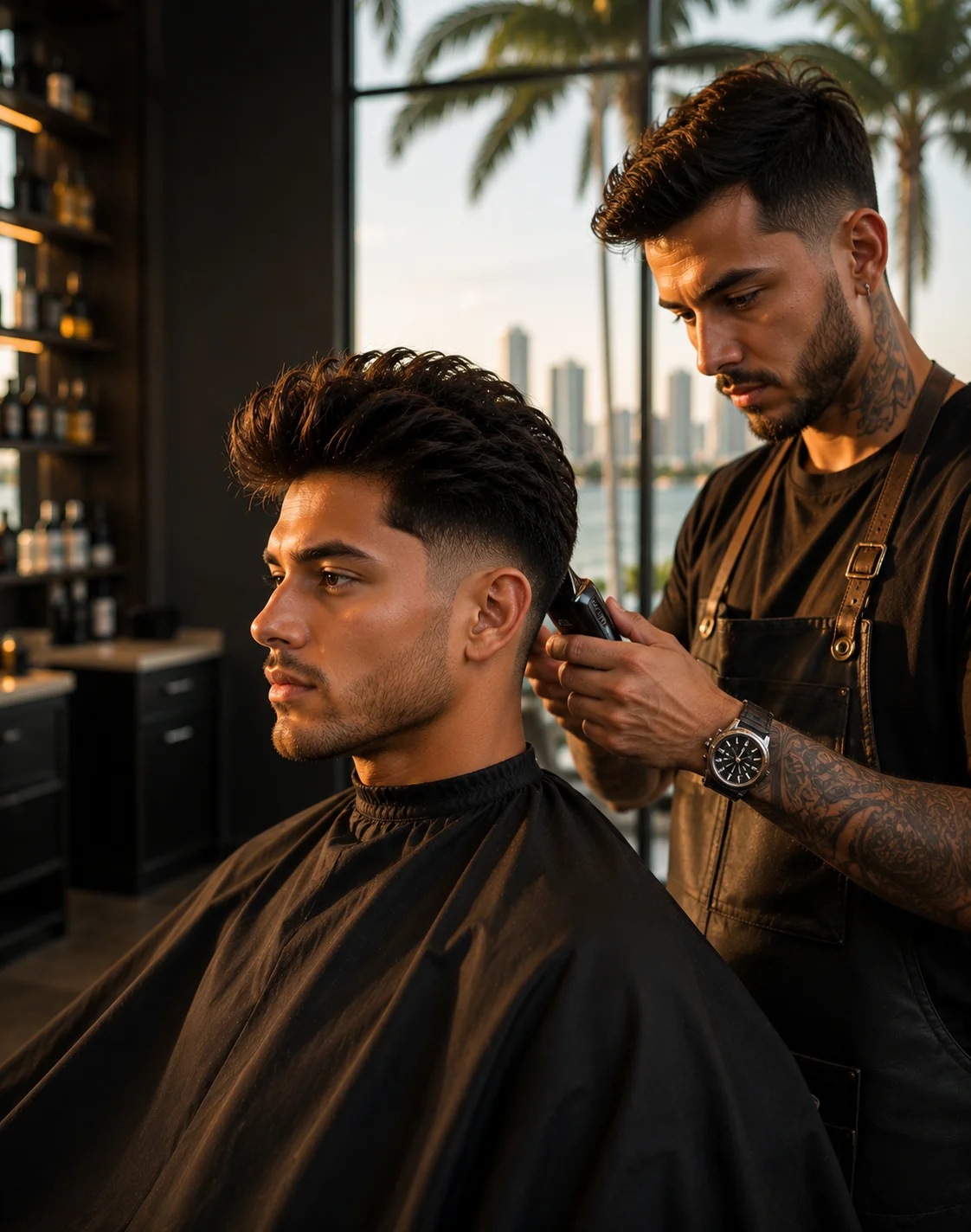
Knowing how to ask for a blowout taper correctly is the difference between walking out with the exact cut you wanted and spending two weeks growing out a miscommunication. Most guys either say too little — "just clean it up" — or use vague terms the barber interprets differently than intended. One clear sentence plus four specific add-ons eliminates that gap entirely.
I've been on the receiving end of thousands of chair consultations in Miami. The clients who communicate well get the best results every single time — not because they know more about barbering, but because they remove the guesswork before the clippers start. This page gives you exactly what to say.
How to Ask for a Blowout Taper: The Core Script
Start with this one sentence — it covers the essential information every barber needs:
"I'd like a blowout taper — [low / mid / high] taper on the sides and back, keep the top long with texture so I can blow it out at home."
Replace [low / mid / high] with your chosen heightThat sentence tells your barber three things: the cut family (blowout taper), the taper height (the most critical variable), and the top treatment (long and textured for blow-drying). Everything else is refinement. Not sure which height to ask for? Read the styles overview or use the Find Your Cut Quiz before your appointment.
The four add-on details worth stating
| Detail | What to Say | Why It Matters |
|---|---|---|
| Guard numbers | "Take it down to a one at the edges" or "down to skin" | Barbers default differently — skin gives maximum contrast, a 1 is softer and grows out slower |
| Top length | "Take about an inch off the top, keep it at least four inches" | "Just a trim" means something different to every barber — inches removes ambiguity |
| Neckline shape | "Tapered neckline" or "squared off" | A tapered neck grows out cleaner; a squared neck looks sharper but shows regrowth faster |
| Sideburn finish | "Taper them naturally" or "square them off" | Natural suits lower heights; squared adds sharpness to mid and high versions |
Scripts for Each Blowout Taper Height
Here is the full ask for each height — copy whichever matches what you want and adjust the top-length number to suit your hair:
How to ask for a low blowout taper
"Low blowout taper — taper just above the ears and at the neckline, leave the sides mostly intact, keep the top long with texture, at least four inches. Tapered neckline, nothing below a one."
Low blowout taper scriptHow to ask for a mid blowout taper
"Mid blowout taper — start the taper at the temple, wrap it clean around the ear and neckline, keep the top long with texture, at least four inches. Down to a one at the edges, tapered neckline."
Mid blowout taper scriptHow to ask for a high blowout taper
"High blowout taper — take the taper up to the upper temple, skin at the edges, keep the top long with texture, at least four to five inches. Sharp lineup on the hairline, tapered neckline."
High blowout taper scriptAfter your script, show a reference photo. Even with perfect words, a photo removes the last five percent of uncertainty and lets your barber match the exact blend style, top volume, and finish you're picturing.
What Not to Say and Why
Some common phrases cause miscommunication every time:
- "Just clean it up" — tells the barber almost nothing. They'll default to the least amount of work, which may or may not be what you want.
- "Make it look like the photo" without any verbal description — photos help, but without words the barber can't confirm they're seeing the same details you are. Always say the height out loud.
- "Fade the sides" — a fade and a taper are different cuts. A fade takes the entire side down to skin; a taper stays in a narrow band around the hairline. If you say fade and mean taper, you may get more off the sides than you wanted. Read the difference in our blowout taper vs taper fade guide.
- "Not too short" — this phrase has no shared meaning. Specify the guard number or the length in inches instead.
How to Ask for a Blowout Taper FAQs
Do I need to know the guard numbers when asking for a blowout taper?
It helps but it's not required. If you don't know guard numbers, describe the result instead: "I want it very short at the edges, just a shadow" means skin or a 0.5. "I want a softer finish that grows out slowly" means a 1 or 2. Your barber can translate the description into the right number.
Should I bring a photo when asking for a blowout taper?
Yes, always. A photo alongside your verbal description closes the gap between what you picture and what the barber pictures. Save two or three reference images — one for the top, one for the taper — so you can show different angles if needed.
What if my barber doesn't know what a blowout taper is?
Describe it instead: "I want the sides tapered — short at the edges, longer toward the top — and the top kept long, four or five inches, cut with texture so I can blow-dry it upward for volume." Any barber can execute that description even without knowing the specific name.
How do I ask for adjustments if the cut isn't right?
Speak up before you leave the chair — that's the only time a correction costs nothing. Say specifically what's different from what you wanted: "The taper feels a bit high for me, can we soften the blend?" is clearer and easier to fix than "it doesn't look right."
Ready for the Chair
Know what to say — now pick your exact style or learn the technique: